Annual Compliance for Private Limited Company
Business / Jun 26, 2026
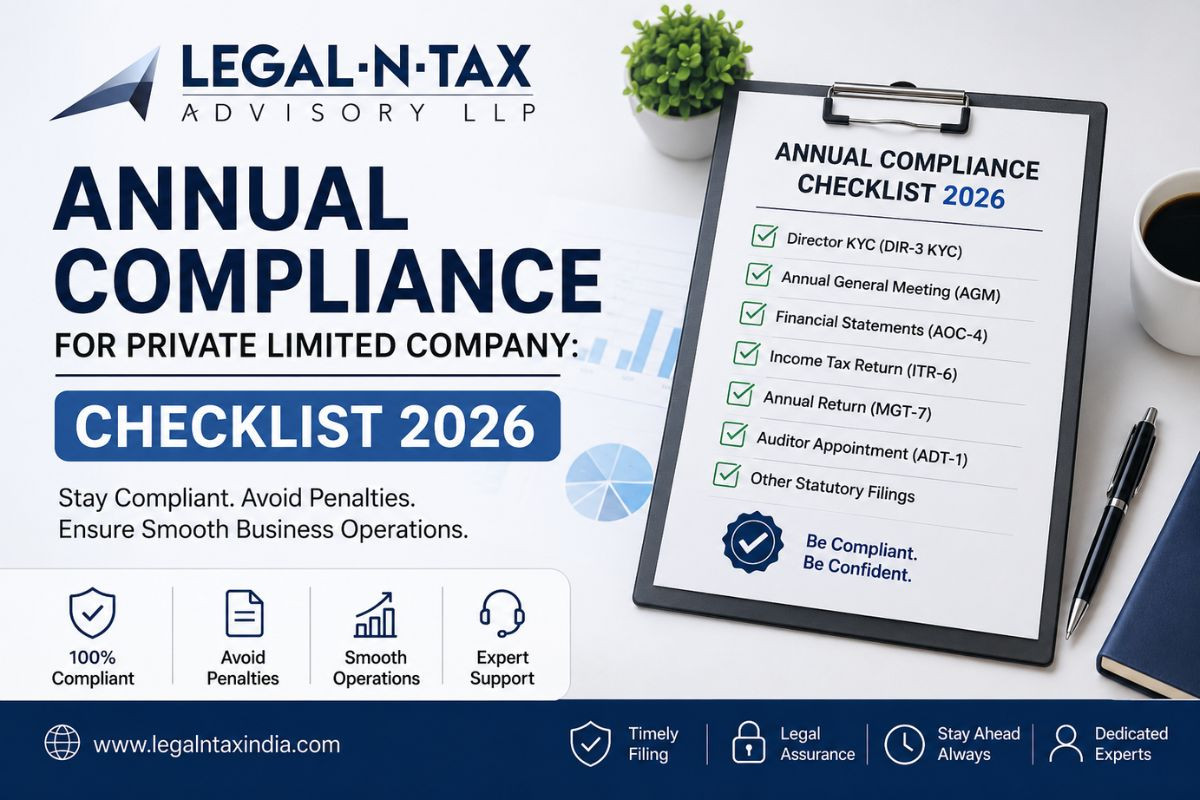
Every private limited company in India — regardless of turnover, profit, or whether it did any business at all during the year — must complete these core annual compliances:
- AOC-4 — file audited financial statements with ROC within 30 days of AGM
- MGT-7 — file annual return with ROC within 60 days of AGM
- ADT-1 — intimate auditor appointment within 15 days of AGM
- DIR-3 KYC — every director must verify their DIN by 30th September each year
- ITR-6 — file income tax return by 31st October (for companies requiring audit)
- AGM — hold Annual General Meeting on or before 30th September each financial year
- Board Meetings — minimum 4 per year, with gaps not exceeding 120 days between any two
- GST and TDS returns — ongoing monthly/quarterly obligations throughout the year
Miss any of these and the penalties start at ₹100 per day per form with no upper cap — and in some cases, directors face personal liability.
The Real Cost of Ignoring Compliance
There's a version of this conversation that happens every year in CA and CS offices across India. A startup founder, or the director of a small family-run private limited company, walks in sometime around November or December — often after a bank loan got rejected, or after receiving a notice from the ROC — and says some version of "we forgot to file our annual returns."
The math that follows is rarely pleasant. ₹100 per day per form, running from the due date to the actual filing date. If AOC-4 and MGT-7 are both delayed by 200 days, that's ₹40,000 in late fees — before any professional fees, and before any separate penalties that an officer under the Companies Act might levy.
And that's the straightforward scenario. If a director's DIN gets deactivated because DIR-3 KYC wasn't filed, it blocks every other filing that requires that director's signature. The company effectively freezes from a compliance standpoint until the DIN is reactivated.
The intent of this guide is to make sure that conversation never happens to your company.
What Is Annual Compliance for a Private Limited Company?
In plain terms, it's the package of legal obligations — filings, meetings, audits, tax returns, records — that every private limited company must complete each financial year under the Companies Act 2013, Income Tax Act 1961, GST law, and various other regulations.
What catches people off guard is that these obligations apply even to companies that are dormant. No transactions, no revenue, no employees — doesn't matter. If your company is registered and active with the MCA, the compliance clock runs.
The obligations broadly fall into four buckets:
- ROC/MCA filings — forms filed with the Registrar of Companies
- Income tax compliance — annual return, tax audit if applicable, advance tax
- GST and TDS compliance — ongoing throughout the year
- Internal governance — meetings, statutory registers, auditor appointment
ROC / MCA Annual Filings — The Core Obligations
Form AOC-4: Filing of Financial Statements
This is the form through which a company submits its audited financial statements to the Registrar of Companies — balance sheet, profit and loss account, director's report, auditor's report, and (if IND AS applies) cash flow statement and statement of changes in equity.
Due date: Within 30 days of the AGM. Since most companies hold their AGM by 30th September, AOC-4 is typically due by 30th October.
Late filing fee: ₹100 per day from the due date, with no upper limit.
Companies with a turnover above ₹500 crore, or listed companies, file AOC-4 XBRL (a structured data format). Most private limited companies file the regular AOC-4.
Form MGT-7 / MGT-7A: Annual Return
The annual return is a separate document from financial statements — people often confuse the two. MGT-7 contains information about the company's share capital, shareholding pattern, board composition, directors, KMPs (Key Managerial Personnel), registered office, and meetings held during the year. It's essentially a snapshot of the company's corporate structure at year-end.
Small companies and One Person Companies file MGT-7A, which is an abridged version.
Due date: Within 60 days of the AGM — so typically by 29th November for most companies.
Late filing fee: ₹100 per day, no ceiling.
Form ADT-1: Auditor Appointment
Every company must appoint a statutory auditor, and the Registrar needs to be informed of that appointment. ADT-1 is the form for this.
Due date: Within 15 days of the AGM.
This becomes especially important in years when a company is rotating its auditor, or appointing one for the first time after incorporation.
Form DIR-3 KYC: Director KYC
Every individual who holds a Director Identification Number (DIN) — whether they are currently serving as a director anywhere or not — must complete KYC every year. The KYC is done through DIR-3 KYC, where the director submits their PAN, Aadhaar, mobile number, and email for verification.
Due date: 30th September each year.
Consequence of missing it: The DIN gets deactivated. A deactivated DIN means that director cannot sign any company filings, cannot be appointed or resign from any company, and the company effectively cannot complete any ROC filings that require that director's authorisation. Reactivation requires paying a ₹5,000 fee.
Form DPT-3: Return of Deposits
If the company has received any loan from directors, shareholders, or third parties that could be classified as deposits, DPT-3 must be filed annually — even if the company has exempted deposits.
Due date: 30th June each year (for the financial year ending 31st March).
Penalty for non-filing: Can go up to ₹10 crore or twice the amount involved, whichever is lower. For individual officers in default, imprisonment up to 7 years is possible under Section 76A.
Form MSME-1: Outstanding Payments to MSME Suppliers
If your company has unpaid dues to MSME suppliers outstanding for more than 45 days, MSME-1 needs to be filed half-yearly.
Due dates: 30th April (October to March period) and 31st October (April to September period).
Penalty: Up to ₹20,000 on the company, plus daily fines on defaulting directors.
Annual General Meeting (AGM)
Every private limited company must hold an AGM each financial year. The AGM is where directors present the audited accounts to shareholders, get them adopted, discuss dividend (if any), and confirm the auditor's appointment.
Deadline: On or before 30th September of the following financial year — so for FY 2025-26, the AGM must happen by 30th September 2026.
First year: A company incorporated in its first financial year gets 9 months from the financial year-end to hold its first AGM.
Penalty for missing it: ₹25,000 on the company, and ₹5,000 on each defaulting officer under Section 99 of the Companies Act.
Board Meetings: What the Law Actually Requires
Minimum Requirement
A private limited company must hold at least 4 board meetings per year, with not more than 120 days between any two consecutive meetings.
For small companies (paid-up capital below ₹2 crore or turnover below ₹20 crore), the minimum is 2 board meetings per year.
Notice Period
A minimum of 7 days' notice must be given before each board meeting. Notice must be sent to every director at their registered address — physical address, email, or both.
What Typically Gets Covered
Board meetings deal with major operational and financial decisions — approving financials, authorising borrowings, approving related party transactions, reviewing compliance status, and recording resolutions for the minutes.
Minutes of every board meeting must be prepared and maintained in the statutory register. These are not filed with the ROC but must be available for inspection.
Income Tax Compliance
ITR-6: Company Income Tax Return
Every company registered in India must file its income tax return in ITR-6, regardless of whether it made a profit, had any income, or was operational during the year.
Due date: 31st October of the assessment year (for companies requiring audit, which includes most private limited companies). So for FY 2025-26, the deadline is 31st October 2026.
Penalty for non-filing: Up to ₹10,000 under Section 271F, plus interest under Sections 234A, 234B, and 234C on any tax liability.
Tax Audit Under Section 44AB
Companies with a turnover above ₹1 crore (₹10 crore if cash transactions are below 5% of total) must have their accounts audited by a Chartered Accountant before the ITR is filed. The audit report is filed in Form 3CA-3CD.
Advance Tax
If a company's total tax liability for the year exceeds ₹10,000, it must pay advance tax in four instalments:
| Instalment | Due Date | Amount to Be Paid |
|---|---|---|
| 1st | 15th June | 15% of estimated annual tax |
| 2nd | 15th September | 45% (cumulative) |
| 3rd | 15th December | 75% (cumulative) |
| 4th | 15th March | 100% (cumulative) |
Missing advance tax payments attracts interest under Sections 234B and 234C.
GST and TDS Compliance
These run throughout the year, not just during the annual compliance season — but they're part of the overall obligation picture.
GST Returns
| Return | Purpose | Frequency |
|---|---|---|
| GSTR-1 | Outward supply details | Monthly (or quarterly for small taxpayers) |
| GSTR-3B | Summary return + tax payment | Monthly or quarterly |
| GSTR-9 | Annual GST return | Once a year (by 31st December) |
| GSTR-9C | Reconciliation statement | For companies with turnover above ₹5 crore |
TDS Returns
Companies paying salaries, professional fees, rent, contractor payments, or any other TDS-applicable amounts must:
- Deduct TDS at applicable rates
- Deposit TDS by the 7th of the following month (for all months except March, which is due by 30th April)
- File quarterly TDS returns — Form 24Q for salaries, Form 26Q for all other payments
Statutory Registers — What Needs to Be Maintained
The Companies Act requires private limited companies to maintain a set of statutory registers. These don't get filed with anyone — they're internal records that must be available for inspection at the company's registered office.
Key registers include the Register of Members, Register of Directors and KMPs, Register of Charges, Register of Loans and Investments, and Minutes Books (for board meetings and general meetings).
These need to be updated regularly — not just at year-end — and any failure to maintain them can attract penalties.
Penalty Summary — What Non-Compliance Actually Costs
| Default | Penalty |
|---|---|
| Late AOC-4 or MGT-7 filing | ₹100 per day per form, no upper cap |
| Missed AGM | ₹25,000 (company) + ₹5,000 per officer |
| DIR-3 KYC not filed | ₹5,000 per director (DIN deactivation) |
| DPT-3 not filed | Up to ₹10 crore or twice the deposit amount |
| MSME-1 not filed | Up to ₹20,000 (company) + daily fines on directors |
| Income Tax Return not filed | Up to ₹10,000 + interest at 1% per month |
| Director disqualification (Section 164) | Cannot be appointed in any company for 5 years |
Annual Compliance Calendar — Key Dates at a Glance
| Compliance | Due Date |
|---|---|
| MSME-1 (Oct–Mar period) | 30th April |
| DIR-3 KYC for all directors | 30th September |
| AGM | On or before 30th September |
| ADT-1 (Auditor Appointment) | Within 15 days of AGM |
| AOC-4 (Financial Statements) | Within 30 days of AGM |
| ITR-6 (Income Tax Return) | 31st October |
| MGT-7 (Annual Return) | Within 60 days of AGM |
| MSME-1 (Apr–Sep period) | 31st October |
| GSTR-9 (Annual GST Return) | 31st December |
| DPT-3 (Return of Deposits) | 30th June |
Frequently Asked Questions
Is annual compliance mandatory even if the company had no business activity?
Yes, absolutely. A dormant or inactive private limited company is still required to file AOC-4, MGT-7, ITR-6, and complete DIR-3 KYC for directors. The only route to avoiding this is formal strike-off or dormancy declaration — but that's a separate process.
What is the difference between AOC-4 and MGT-7?
AOC-4 is for financial statements — balance sheet, P&L, auditor's report. MGT-7 is the annual return — company structure, shareholding, directors, meetings. They're separate filings with separate due dates. Both are mandatory.
What happens if the AGM isn't held on time?
The company faces a penalty of ₹25,000, and each defaulting officer pays ₹5,000. Beyond that, it cascades — if there's no AGM, the financial statements can't be adopted by shareholders, which affects the AOC-4 and MGT-7 due dates and filings.
Who is responsible for compliance — the directors or the company secretary?
Both. Directors are legally responsible under the Companies Act. A Company Secretary (if appointed) handles the practical execution. For companies below a certain threshold that don't have a mandatory CS, a professional firm handles the filings. But legal liability for defaults sits with the directors.
Can a company file overdue returns even after years of non-compliance?
Yes, though the accumulated late fees can be significant. In some cases, the MCA runs condonation of delay schemes that allow companies to clear backlogs at reduced fees. Legal-N-Tax Advisory can assess your company's specific situation and advise on the most efficient path to clearing outstanding filings.
Is there a penalty if the board meeting notice period isn't met?
Yes. If proper notice isn't given before a board meeting, the meeting and any resolutions passed at it may be invalid, and officers can be penalised. The 7-day notice requirement is specific, with an exception only for urgent matters with consent of directors.
Looking for Annual Compliance Services in Delhi?
Legal-N-Tax provides complete solutions for Pvt Ltd Companies to meet all legal & regulatory needs.
Our team handles the full cycle — statutory audit coordination, ROC filings (AOC-4, MGT-7, ADT-1, DIR-3 KYC), income tax returns, GST compliance, board meeting documentation, and statutory register maintenance. We work with startups, SMEs, and established companies — and with foreign subsidiaries that need to navigate both Indian company law and parent-company reporting.
115, Lower Ground Floor, Sector-12A Rd, Block A, Sector 12 Dwarka, Dwarka, New Delhi, Delhi, 110078
📞 +91-9810911733 📧 mail@legalntaxindia.com 🌐 www.legalntaxindia.com ⭐ Find us on Google Maps
Related Reading from Legal-N-Tax Advisory
- Company Annual Compliances for Private Limited
- Company Registration in India
- Income Tax Compliance
- GST Compliance Services
- GST Return Filing
- Tax Audit Services
- How to File ITR Online: Step-by-Step Guide (AY 2026-27)
- GST Registration for New Business: Complete Guide
- What Does an Income Tax Consultant Do?
(All articles: legalntaxindia.com/blog)
Share this with others: