How to Register an NGO in India: Step-by-Step Guide 2026
Business / Jul 23, 2026
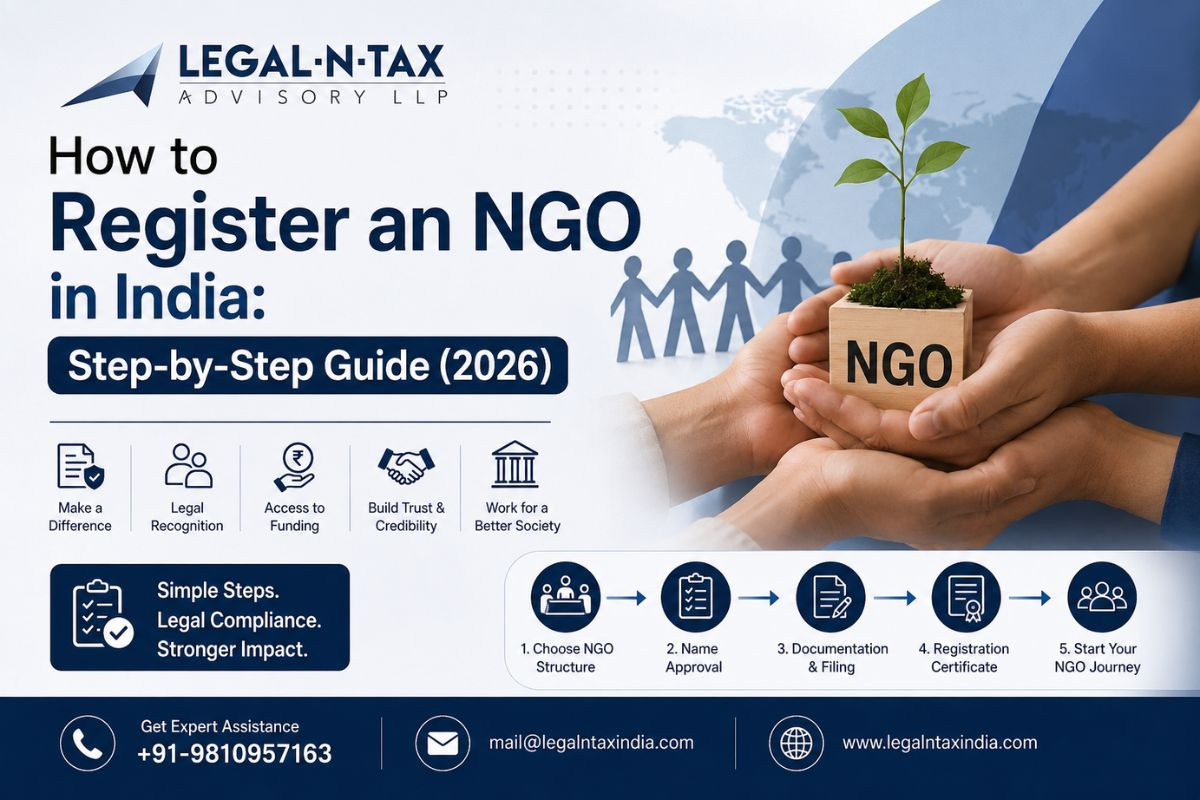
There is no single "NGO Act" in India. You pick one of three legal structures - Trust, Society, or Section 8 Company - and register under that. Each has its own authority, its own paperwork, and its own compliance trail.
Trust registration? Two trustees, a deed on stamp paper, a visit to the Sub-Registrar's office. Society? Seven founding members, a Memorandum of Association, the Registrar of Societies. Section 8 Company? Digital signatures, DIN numbers, the MCA portal, the whole thing.
Once you have the registration, you still need 12A (so your income isn't taxed), 80G (so your donors get a tax deduction), and NGO Darpan on ngodarpan.gov.in (increasingly required before any government grant or CSR fund moves toward you).
Start to finish - registration certificate in hand - usually runs 3 to 6 weeks. Depends on your structure and your state.
The Part Most Guides Skip
People come to us after already registering. That happens more than you'd think.
They picked a Trust because it was fast. Or they picked a Society because someone told them it looked more "official." And now, two or three years in, they're trying to access CSR funding that requires a Section 8 structure, or they're dealing with governance disputes that a Trust's lack of democratic rules makes very hard to resolve.
The structure you choose at the start shapes what you can do, who will fund you, and how much compliance you'll carry every year. So before anything else - before the paperwork, before the name, before the stamp paper - sit with that decision properly.
Here's what each structure actually means in practice:
A Trust is fast and flexible, but it runs on personal relationships between trustees. No elections, no membership, no democratic process. Fine for small, focused charitable work. Not ideal if you're planning to bring in multiple stakeholders, apply for large grants, or eventually receive foreign funds.
A Society has a governing committee, elections, annual general meetings, and formal minutes. More credibility than a trust for institutional donors. But it's registered state-by-state, which creates complications if you operate across multiple states.
A Section 8 Company works under the Companies Act. Full corporate governance, annual ROC filings, board meetings, statutory audits. The compliance burden is real. But so is the credibility - with CSR departments, government bodies, foreign funders, and FCRA registration requirements. For serious, scaling NGOs, this is usually where you end up anyway. Better to start there.
Three Structures, Side by Side
| Structure | Law | Minimum Members | Who It Works For |
|---|---|---|---|
| Trust | Indian Trusts Act, 1882 | 2 Trustees | Small charities, religious and welfare causes, focused local work |
| Society | Societies Registration Act, 1860 | 7 Founding Members | Educational bodies, cultural organisations, community groups |
| Section 8 Company | Companies Act, 2013 | 2 Directors (Private) or 3 Directors (Public) | Large-scale NGOs, CSR-funded projects, pan-India or international operations |
How to Register a Trust
This is the fastest route. If you have the right documents and your deed is drafted cleanly, you can walk out of the Sub-Registrar's office the same day.
Work out your objectives first. Not vague ones. "Social welfare" is not an objective. "Running free primary education programmes for children under 12 in low-income urban settlements in Delhi" is an objective. The deed is a legal document and vague language in it causes problems every time you touch a bank account, an exemption application, or a grant requirement.
Pick your trustees. Two is the legal minimum. These people carry legal and fiduciary responsibility for the trust's work and money. Don't treat this as a formality. A trustee who goes unreachable or uncooperative later creates real problems.
Get the Trust Deed drafted. It covers the trust's name, its objectives, the registered address, names and addresses of all trustees, management rules, and what happens if the trust is dissolved. A poorly drafted deed is one of the most common reasons NGO registrations get delayed or create downstream complications.
Buy the stamp paper. Non-judicial stamp paper, value determined by your state. In Delhi, it's generally in the range of Rs. 200 to Rs. 500, but confirm the current rate before purchasing - it varies and changes.
Go to the Sub-Registrar's office. Settlor plus at least two witnesses, original identity and address proof for everyone, the deed. The registrar registers it. You walk out with a registered Trust Deed, which is your foundational document for everything that follows.
Apply for PAN. The trust needs its own PAN card - separate from the trustees' individual PANs. You need this to open a bank account and for all tax filings going forward.
How to Register a Society
More paperwork than a trust, but the governance structure it creates is genuinely more robust for organisations that expect to grow.
Get your founding group together. Seven members minimum. These are your first general body. From them, a governing committee - usually President, Vice President, Secretary, Treasurer - will be constituted.
Choose the name carefully. Run a quick check before you get attached to anything. The name can't be identical or closely similar to an existing registered society, and certain words are restricted under the Emblems and Names Act.
Write the Memorandum of Association. This is your primary document - name, address, objectives, names and addresses of all founding members with their signatures. Take time on the objectives section. Same advice as with the trust deed - specificity matters.
Prepare the Rules and Regulations. This document governs how the society actually functions, how meetings are called. What constitutes quorum. How elections happen. How accounts are maintained and audited. What happens on dissolution. Don't copy a template from the internet - make sure the rules actually reflect how your organisation intends to operate.
Submit to the Registrar of Societies. This is state-specific. Some states have online portals now, others still require physical submission. Along with the MoA and Rules, you'll submit identity and address proofs of all founding members and a covering letter. The government fee is usually modest - under Rs. 1,000 in most states.
Receive the Certificate of Registration. The registrar reviews, may ask for clarifications, and, on being satisfied, issues the certificate. Timeline: 2 to 6 weeks depending on state and workload.
How to Register a Section 8 Company
The most involved process of the three, but also the most recognised structure for serious NGO work.
Get DSC and DIN sorted before anything else. Every proposed director needs a Digital Signature Certificate from a certified authority and a Director Identification Number from the MCA portal. No DSC, no DIN, no progress. Sort these out first - they take a few days.
Reserve your name. Use the RUN service on mca.gov.in. Section 8 companies can use words like Foundation, Organisation, Society, Trust, or Association - which regular for-profit companies cannot. Apply for a name that's available and distinctive.
Draft the MOA and AOA. The Memorandum of Association lays out your charitable objectives. The Articles of Association govern internal operations - board meetings, decisions, financial management. These need to be drafted correctly. Errors here show up later in the worst possible moments - FCRA applications, CSR proposals, statutory audits.
Apply for the Section 8 License. Form INC-12 to the Registrar of Companies. Attach draft MOA and AOA, a declaration from an advocate or CA confirming legal compliance, and a projected income-expenditure statement. The RoC reviews and grants the license if satisfied.
File SPICe+ for incorporation. This is the actual incorporation form on the MCA portal. You also file AGILE-PRO alongside it, which handles GST, EPFO, ESIC, and bank account opening simultaneously. Attach the MOA, AOA, identity/address proofs of directors, and the Section 8 license.
Get the Certificate of Incorporation. The RoC issues this with your Corporate Identity Number. From this point, your NGO legally exists as a Section 8 Company.
After Registration: What Still Needs to Happen
This is the part a lot of first-time founders don't fully account for. The registration certificate is the beginning, not the end.
12A Registration - Income Tax Exemption
Without this, your NGO's income gets taxed at regular rates. With it, income applied toward your charitable purposes is fully exempt. Apply using Form 10A on the income tax e-filing portal at incometax.gov.in.
New NGOs get provisional 12A registration, valid for 3 years. After demonstrating actual activities, you apply for regular registration - valid for 5 years for most organisations, or 10 years for smaller trusts with income below Rs. 5 crore, under the Finance Act 2025 update.
80G Registration - Donor Tax Deductions
80G is what makes your NGO genuinely attractive to donors. Anyone who contributes to an 80G-registered organisation can claim a 50% deduction on that donation from their taxable income. For individuals and companies making meaningful donations, this changes the calculation.
Since 2021, 12A and 80G can be applied for together using a single Form 10A. Apply for both at the same time - no reason to do them separately.
NGO Darpan - NITI Aayog Registration
Register at ngodarpan.gov.in. You get a Unique ID that central government ministries increasingly require before releasing grants. Many corporate CSR departments also check for NGO Darpan registration. Do this early - it's straightforward and costs nothing.
FCRA - For Foreign Contributions
If foreign funds are part of your plan, FCRA registration from the Ministry of Home Affairs is mandatory. The catch: you can only apply after 3 years of operations, and you need to show at least Rs. 15 lakh spent on charitable activities in that period. Plan for this timeline from the start.
Documents You Need - Across All Three Structures
| Document | Trust | Society | Section 8 Company |
|---|---|---|---|
| Core Governing Document | Trust Deed | MoA + Rules & Regulations | MOA + AOA |
| Founders' Identity Proof | PAN + Aadhaar of all trustees | PAN + Aadhaar of all members | PAN + Aadhaar of all directors |
| Address Proof (NGO) | Electricity Bill or Rent Agreement | Electricity Bill or Rent Agreement | Registered Office Proof |
| Photographs | Passport Size of each trustee | Passport Size of each member | Passport Size of each director |
| Digital Signature (DSC) | Not Required | Not Required | Mandatory for each director |
| Director Identification Number (DIN) | Not Required | Not Required | Mandatory for each director |
Mistakes That Actually Derail NGO Registrations
Writing objectives that are too general. Registrars and tax authorities read these documents carefully. "Promoting social welfare" tells them nothing. "Providing skill training to unemployed youth aged 18 to 30 in Delhi NCR" tells them something. The more specific your objectives, the smoother every subsequent application goes.
Choosing a structure based on what's easiest right now. A trust takes three days to register. Great. But if your growth plan involves CSR funding, pan-India operations, or foreign contributions, you'll be restructuring within a few years anyway. Think ahead.
Delaying 12A and 80G applications. There is no good reason to wait. Every month without 12A is a month where surplus income gets taxed. Every month without 80G is a month where your donors have less incentive to give.
Forgetting NGO Darpan. It's free, it's simple, and it's increasingly non-negotiable for institutional funding. Just do it.
Documents that don't match. Name on PAN, name in the governing document, name on address proof - they all need to be consistent. Even minor variations cause rejections or delays.
Frequently Asked Questions
Can I register an NGO online in India?
Section 8 Company registration is fully online via mca.gov.in. Some states have moved society registration online as well. Trust registration still typically needs a physical visit to the Sub-Registrar's office - though the process is straightforward once your documents are ready.
What is the minimum number of people needed?
For a Trust, 2 people - a settlor and at least one trustee. For a Society, 7 founding members. For a Section 8 Company, 2 directors for a private structure, 3 for public.
How long does NGO registration take?
A Trust can be registered in a day or two if documents are clean. Society registration runs 2 to 6 weeks depending on the state. Section 8 Company registration through the MCA process typically takes 3 to 5 weeks.
What does it cost?
Trust registration involves stamp duty on the deed - varies by state, usually Rs. 200 to Rs. 2,000. Society registration fees are generally under Rs. 1,000. Section 8 Company registration through SPICe+ has minimal government fees. Professional service fees are separate.
Can a foreign national be a trustee or director of an Indian NGO?
Yes, with conditions. Foreign nationals can serve as trustees or directors. However, for FCRA registration - which is required to legally receive foreign contributions - there are specific restrictions on foreign nationals holding key management positions.
What is the difference between 12A and 80G?
12A gives the NGO itself a tax exemption on its income. 80G gives the donor a deduction on their contribution. Both are worth having. Apply for them together using Form 10A.
Is GST applicable to NGOs?
Depends on activities. Purely charitable activities that fall under Schedule III of the CGST Act are not subject to GST. If the NGO undertakes any commercial activity - even incidental - and crosses the GST threshold, registration may be required. Worth getting clarity on this before you start operations.
Need Help With NGO Registration in Delhi?
Whether you are starting a Trust, a Society, or a Section 8 Company - and whether you need just the registration or the full package including 12A, 80G, NGO Darpan, and FCRA planning - our team handles the entire process.
We have done this many times. The paperwork is not complicated when you know what you are doing. We make sure it gets done right the first time.
Visit our NGO Registration service page for full details:
📧 mail@legalntaxindia.com 📞 +91-9810957163
Legal-N-Tax Advisory LLP 115, Lower Ground Floor, Sector-12A Rd, Block A, Sector 12 Dwarka, Dwarka, New Delhi, Delhi - 110078
🌐 www.legalntaxindia.com ⭐ Find us on Google Maps
Share this with others: