What Are the Benefits of MSME Registration? Complete Guide (2026)
Business / Jul 27, 2026
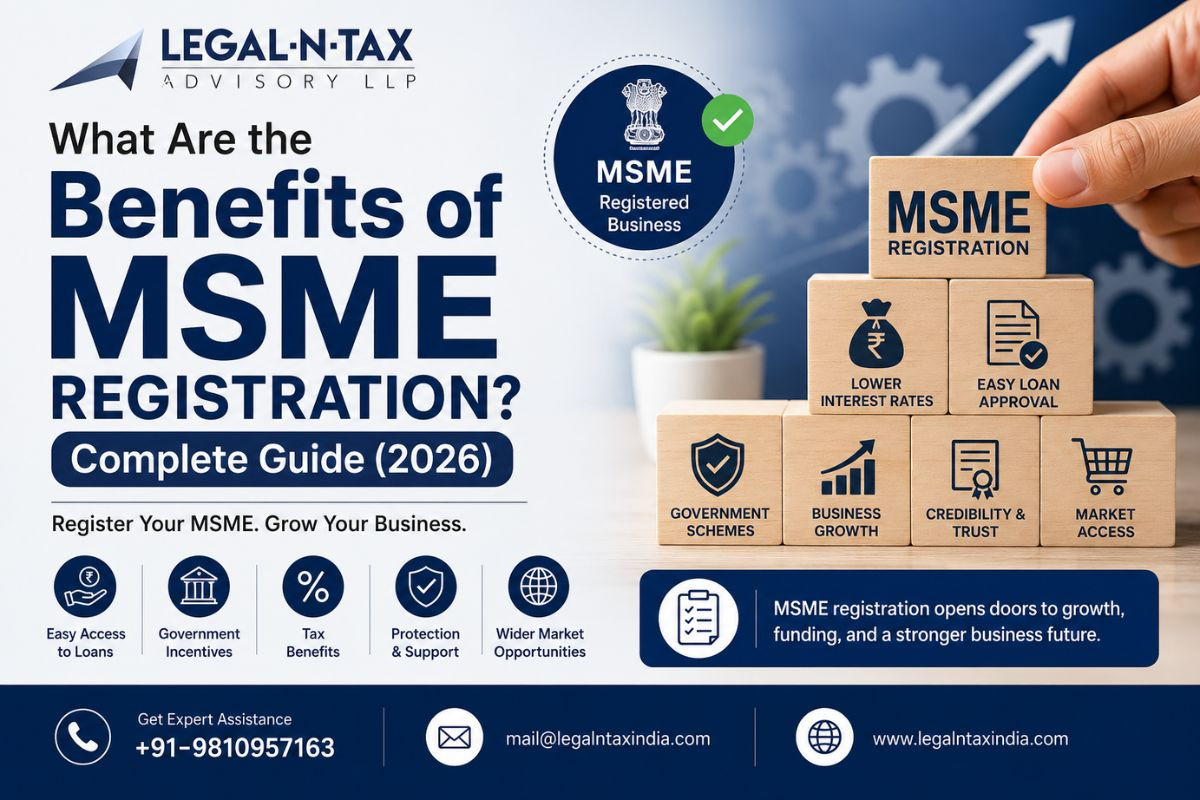
Udyam Registration is free. Takes maybe 10 minutes on udyamregistration.gov.in. You get a 12-digit number that the government, banks, and large corporates all recognise as proof that your business is real and formally classified.
What that number actually unlocks: loans without collateral (up to Rs. 5 crore), lower interest rates, legal protection when clients delay payment beyond 45 days, preference when bidding on government contracts, subsidies on certifications and patent filings, and a credit card with Rs. 5 lakh limit introduced in Budget 2025-26 specifically for micro enterprises.
April 2025 brought revised eligibility limits - higher than before. Micro Enterprise threshold is now Rs. 2.5 crore investment and Rs. 10 crore turnover. Small Enterprise goes up to Rs. 25 crore investment, Rs. 100 crore turnover. Many businesses that didn't qualify previously now do.
Not mandatory. But skipping it is skipping real, accessible benefits that cost nothing to claim.
What Is MSME Registration?
The full name is Udyam Registration. It replaced Udyog Aadhaar and EM-II back in July 2020. If you're still carrying one of the old certificates, you need to re-register - the old ones don't transfer automatically to the new system.
When you complete registration, you get a Udyam Certificate with a unique 12-digit Udyam Registration Number (URN) and a QR code. No physical document is posted. Digital, downloaded from the portal, valid for life. No renewal, no fees, ever.
The certificate is what the entire benefit ecosystem sits behind. Government schemes, bank loan programs, procurement portals, subsidy applications - all of them use Udyam registration status as the qualifying condition.
One thing worth saying clearly: the official portal is udyamregistration.gov.in. There are many copycat websites that look similar and charge a fee. Udyam Registration from the government is completely free. If you are paying someone to process it, you are paying for something that takes 10 minutes and costs nothing to do yourself.
Who Can Apply for MSME Registration?
Classification uses two numbers: what you have invested in plant, machinery, or equipment, and what your annual turnover is. A business has to stay within both limits to qualify for a given category. Cross either one and you move up.
| Category | Investment Limit | Annual Turnover Limit |
|---|---|---|
| Micro Enterprise | Up to Rs. 2.5 crore | Up to Rs. 10 crore |
| Small Enterprise | Up to Rs. 25 crore | Up to Rs. 100 crore |
| Medium Enterprise | Up to Rs. 125 crore | Up to Rs. 500 crore |
These are the revised limits from April 1, 2025. Significantly higher than previous thresholds. Many businesses that were previously ineligible or classified differently now need to take another look.
Manufacturing businesses, service providers, traders, retailers, e-commerce sellers, freelancers with structured operations - all eligible if within the limits. What doesn't qualify: businesses above Medium Enterprise limits, NGOs, government departments, completely informal operations with no business identity.
All units under the same PAN are aggregated when calculating thresholds. If you run multiple businesses under one PAN, the combined figures determine your classification.
Why MSME Registration Is Important - The Real Reasons
People usually hear "collateral-free loans" and "government subsidies" as the headline benefits. Those are real. But the picture is more layered.
The payment protection angle is one most small businesses don't fully understand until they need it. Under Section 15 of the MSMED Act 2006, buyers who receive goods or services from a Micro or Small Enterprise must pay within 45 days. No agreement to the contrary, 15 days is the limit. Miss that window and the buyer is liable for compound interest at three times the RBI bank rate. You file through the MSME Samadhaan portal and the case goes to a Facilitation Council.
For anyone who has waited 90 or 120 days for payment from a large client and had no legal recourse, this changes the situation completely.
Section 43B(h) changed how large businesses think about paying MSME suppliers. Finance Act 2023 brought this in. If a company owes money to an MSME supplier, they can only claim that expense as a tax deduction in the year payment is actually made. Delay past 45 days and the deduction shifts to next year. That gives your corporate clients a real tax reason to pay you on time. Your registration directly affects how fast you collect.
The government procurement piece is also bigger than most people realise. The mandatory Public Procurement Policy reserves 25% of all central government procurement for MSMEs. A defined portion of every ministry's annual spending sits in a pool that only registered businesses can access. Without Udyam registration you are simply not in the running for that category.
Tax Benefits of MSME Registration
Presumptive Taxation under Section 44AD allows businesses with turnover under Rs. 3 crore to declare income at a flat 8% of turnover (6% for digital receipts) without detailed accounts. Simpler compliance, less documentation. Whether this beats normal assessment depends on your actual margins, but for many small businesses it removes a significant compliance burden.
The payment deduction timing benefit works both ways. When you pay an MSME-registered supplier, you claim the deduction in the year payment is made. Section 43B(h) also means your buyers face tax pressure to pay you within 45 days. The registration creates a two-way discipline around payment timing that benefits cash flow on both ends.
State-level tax incentives add another layer. Several states offer concessions, deferrals, and fiscal benefits exclusively to MSME-registered entities. These vary considerably. Worth checking what your state offers specifically through the state's MSME department or Udyog Bandhu scheme.
MSME Loan Benefits - What Is Actually Available
The credit picture for registered MSMEs is genuinely more accessible than for unregistered small businesses.
CGTMSE backs loans up to Rs. 5 crore without requiring property or assets as security. The Credit Guarantee Fund Trust provides the guarantee to the bank. For businesses that don't own significant assets, this removes the single biggest barrier to formal credit.
Banks offer Udyam-registered businesses rates typically 1% to 1.5% below standard commercial lending rates. Across the life of a term loan that is a material saving.
MSMEs fall under RBI's Priority Sector Lending norms, which means banks have regulatory quotas to fill. Your application gets different treatment - faster processing, more flexibility.
Mudra Loans under PMMY come in four tiers: Shishu up to Rs. 50,000, Kishore up to Rs. 5 lakh, Tarun up to Rs. 10 lakh, and Tarun Plus up to Rs. 20 lakh for businesses with clean repayment history. Designed specifically for small and micro businesses.
The PSB Loans in 59 Minutes portal at psbloansin59minutes.com allows Udyam-registered MSMEs to get in-principle approval within an hour. Not disbursement - that still follows normal process - but the initial decision is dramatically faster.
The ME-Card is new as of Budget 2025-26. A credit card specifically for Udyam-registered Micro Enterprises with investment under Rs. 1 crore and turnover under Rs. 5 crore. Credit limit of Rs. 5 lakh. Verified instantly through the Udyam database, no separate documentation needed. The government announced 10 lakh such cards in the first year of the scheme. For micro businesses that need small working capital access without loan paperwork, this is directly useful.
Government Subsidies Available for MSMEs
| What It Covers | Scheme | Benefit |
|---|---|---|
| Loan guarantee without collateral | CGTMSE | Up to ₹5 crore credit guarantee support |
| Technology and machinery upgrade | CLCSS | 15% capital subsidy (up to ₹15 lakh) |
| ISO certification costs | Reimbursement Scheme | Reimbursement amount varies by state |
| Patent and trademark filing | IP Subsidy for MSMEs | 50%–80% reimbursement of eligible fees |
| Export promotion and trade fairs | Market Development Assistance (MDA) | Partial reimbursement of travel and exhibition booth expenses |
| Working capital credit line | ME-Card | Credit facility up to ₹5 lakh |
| Emergency and operational credit | ECLGS Extension | Support extended under Budget 2025–26 announcements |
State governments add their own layer. Power tariff concessions for manufacturing units, land allotment preference in industrial estates, capital investment incentives. All variable by state, but Udyam registration is the entry requirement for all of them.
Benefits for Startups and Small Businesses
If your business is new or recently formalised, the Udyam Certificate does something specific: it gives you a government-issued identity before you have years of financial history.
Banks and NBFCs use it as a credibility signal when assessing newer businesses. A startup with a Udyam Certificate is easier to underwrite because the government has already verified the business activity and classification. Without it, a new business is harder to assess and lending decisions slow down or tighten.
The GeM marketplace integration means government procurement opportunities open from day one. The Udyam portal connects directly with GeM. One government contract in the first two years can genuinely change a small business's direction.
And Section 43B(h) means that once you have Udyam registration, larger companies you invoice have a tax reason to pay you within 45 days. Receivables tighten. Cash flow improves. For a young business managing every rupee, that matters more than almost anything else on this list.
Is MSME Registration Mandatory?
No. Not legally required.
But "optional" is a misleading frame here. Every benefit covered in this article sits behind this registration. It's free. It takes 10 minutes. The benefits accumulate over every year you operate.
The real question is not whether to do it. It's why so many eligible businesses haven't done it yet.
How to Apply for Udyam Registration Online
Go to udyamregistration.gov.in. Only this site. Ignore every other portal that asks for a fee.
For businesses with Aadhaar and PAN, click "For New Entrepreneurs who are not Registered yet as MSME." Enter the Aadhaar number and name of the proprietor, managing partner, or director. OTP goes to the Aadhaar-linked mobile. Validate it.
Fill in business details - trade name, type of business (manufacturing, service, or trade), address, GSTIN if applicable, PAN, bank account details, NIC code for your main activity, number of employees, investment figure, and annual turnover.
The system cross-checks with ITR and GST databases automatically. No documents uploaded. Review everything - name, turnover figure, activity code - and submit.
Certificate is issued instantly. Download it with the URN and QR code. It also arrives on the registered email. Done.
No Aadhaar? Use the Udyam Assist Platform (UAP), launched in 2023 for street vendors and informal artisans without a GSTIN.
Already have Udyog Aadhaar? Re-register on Udyam. Old certificates don't carry the current benefits and don't transfer automatically.
Frequently Asked Questions
Is Udyam Registration the same as MSME registration?
Yes. Udyam Registration is the official name of the current MSME registration system. Launched July 2020, it replaced Udyog Aadhaar and EM-II. The terms are used interchangeably.
Is MSME registration really free?
Completely. Zero government fee, zero renewal, zero certificate charge. Anyone charging you for this is not operating through official channels.
How long does it take?
The certificate comes out the moment you submit correctly. The full process is about 10 to 15 minutes from opening the portal to downloading the certificate.
What documents are needed?
Aadhaar, PAN, GSTIN (if registered), bank account details, and basic business information. Nothing is uploaded - the portal validates against government databases automatically.
Can traders and retailers apply?
Yes, fully. As of recent policy updates, trading and retail businesses qualify as MSMEs provided they fall within the investment and turnover limits.
What happens when my business crosses the MSME threshold?
Classification upgrades automatically as the system cross-verifies against tax databases. If you cross the Medium Enterprise ceiling entirely, registration gets cancelled - but there is a grace period during which benefits continue.
Can I register multiple businesses?
Yes, but all units under the same PAN are aggregated for threshold calculation. Separate registrations are possible but combined figures determine classification.
Is GST registration required before Udyam?
Not for all categories. Micro enterprises below the GST threshold can register on Udyam without a GSTIN. Businesses that have GSTIN get it verified automatically during the Udyam process.
Get Help with MSME Registration
Our team at Legal-N-Tax Advisory handles MSME registration and post-registration compliance for businesses across Delhi and India.
Visit our MSME Registration service page:
Email: mail@legalntaxindia.com Call: +91-9810957163
Legal-N-Tax Advisory LLP 115, Lower Ground Floor, Sector-12A Rd, Block A, Sector 12 Dwarka, Dwarka, New Delhi, Delhi - 110078
Website: www.legalntaxindia.com Google Maps: Find us here
Share this with others: